
Learning from and sharing best practice to tackle domestic abuse is an important priority for the Domestic Abuse Commissioner. As part of this work, she recently visited Gloucester to learn about the innovative work they’re doing to bring together specialist services, the local authority and policing to better support victims and survivors.
In this blog, Sophie Jarrett, VAWG Policy and Strategy Lead at the Gloucestershire Domestic Abuse Partnership sets out how the team works and the role collaboration plays in improving outcomes for people experiencing domestic abuse.
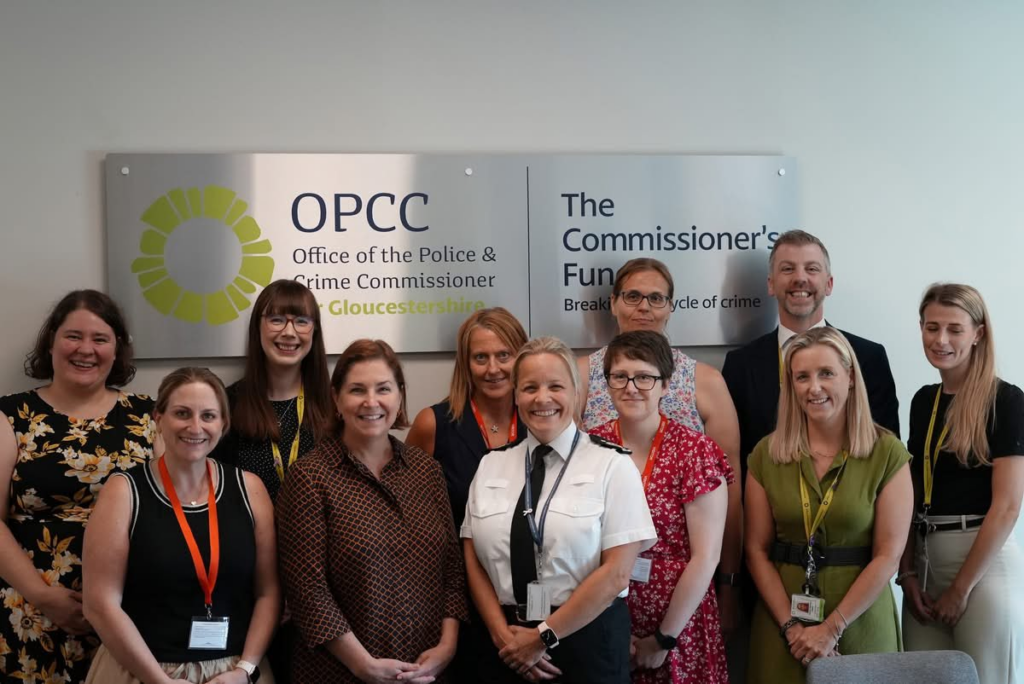
As the VAWG and Domestic Abuse Policy and Strategy Lead, I hold a unique shared position between the Office of the Police and Crime Commissioner (OPCC), Gloucestershire County Council (GCC) and Gloucestershire Constabulary. This means that my role is not only jointly owned, but also jointly funded, recognising the shared objectives across the partnership and buy in for this area of work.
My role provides a broad perspective across the county, enabling me to work with partners from a range of organisations while keeping a clear focus on improving outcomes for victims and survivors. One of the things I value most about my role is the opportunity to work across organisational boundaries to help improve the way we respond to some of the most complex and challenging issues facing our communities.
The term VAWG – violence against women and girls – is one I’m sure you’re all familiar with. It is worth caveating that while VAWG captures offences which disproportionally impact women and girls, the work of the team I’m in has a remit for all victims of these offences. Therefore, we ensure the inclusion of male, transgender and non-binary victims in all of our work to tackle domestic abuse, sexual violence, stalking, honour-based abuse and forced marriage.
A significant part of my work involves leading the development of Gloucestershire’s needs assessments and strategies for domestic abuse, sexual violence and other forms of VAWG. Having this detailed understanding of local need helps ensure that our plans and resources are targeted where they can make the greatest difference. An example of this has been the Gloucestershire Domestic Abuse Training pathway, which we developed after identifying the need for consistent training to be made available for practitioners in the county. We have now commissioned a training offer which aims to increase confidence and competence in responding to domestic abuse across all risk levels.
My role also involves bringing partners together to respond to emerging issues. We know criminals and abusers will always continue to find new ways to control or hurt someone. Staying on top of these emerging trends can be difficult, but it’s important to make sure we’re supporting victims and survivors.
As a result of this focus, Gloucestershire has an established approach of co-locating domestic abuse specialists within other services, such as health, police, children’s services and substance misuse services. Our local specialist services also support in a pre-release process, ensuring victims are safeguarded prior to a perpetrator being released from prison.
This work means establishing and leading thematic working groups that enable agencies to share expertise, coordinate activity and develop consistent approaches which can be shared and replicated across the county. Current examples include work focused on domestic abuse, suicide prevention and teenage relationship abuse. In the case of teenage relationship abuse, this collaborative approach extends beyond local partners, with academics helping us better understand the issue and identify evidence-based solutions.
Alongside strategic development, I also lead on local policy and guidance, helping to ensure that professionals across Gloucestershire have access to clear, consistent information that supports effective practice. I work closely with commissioned service providers and partner agencies, helping to identify and address barriers that may affect support for victims and survivors. I also oversee Domestic Abuse Related Death Reviews (DARDRs), ensuring that learning is captured and used to strengthen future responses.
One of the greatest advantages of working across three organisations is the ability to maintain what I often describe as a “helicopter view” of the partnership landscape. The role provides insight into the work taking place across multiple sectors while also maintaining strong links into policing. This allows me to understand national developments, share learning between organisations and support initiatives that benefit from both a policing and partnership perspective.
I am fortunate to work as part of a wider team that shares a commitment to collaboration. Alongside my role, we have a Consultation Coordinator whose focus is ensuring that the voices of people with lived experience are heard and reflected in our work. They also work with community groups to increase engagement across protected characteristics, supporting our understanding of the needs within all of our communities and increasing awareness. This work helps shape the services that are commissioned, ensuring we are responding to what victims and survivors tell us they want. We also have a VAWG and Domestic Abuse Research Officer who helps bring emerging evidence, research and best practice into our approach. Both roles are jointly funded and shared, reinforcing the collaborative nature of our work. And both roles are delivered to perfection by my two colleagues!
We work particularly closely with Gloucestershire County Council’s Public Health team, who lead on domestic abuse commissioning for the county. Positioning domestic abuse within public health supports the whole system approach which has been championed in this space, and allows us to deliver earlier help and preventative work alongside other support. Together we support the Domestic Abuse Partnership Board and its delivery plan, ensuring that strategic priorities are translated into meaningful action. This partnership also provides valuable opportunities to contribute to discussions about how domestic abuse grant funding can be used most effectively across Gloucestershire.
What stands out to me most is the genuine sense of being one team. Although we are employed by different organisations, there is a strong culture of collaboration and a shared commitment to achieving better outcomes for victims and survivors.
At the heart of everything we do is the voice of lived experience. Listening to victims and survivors helps shape our strategies, informs the services we commission and ensures that our work remains focused on the people it is ultimately designed to support. Their experiences and insights continue to guide our efforts as we work together to create a safer Gloucestershire for everyone.
I truly love my job and care deeply about the victims and survivors I know our combined efforts help.
If you would like to learn more about how the Gloucestershire Domestic Abuse Partnership works, please email [email protected].